At the nanoscale, thermal motion of molecules constantly agitates fluid interfaces, creating capillary waves only nanometres in height. These thermal fluctuations, although tiny, can control the behaviour of drops, films and jets. Understanding their role is essential for predicting how fluids behave when pushed into the nanoscale, where conventional fluid models begin to break down.
Nanowaves on a Thin Liquid Film
Our research uses fluctuating hydrodynamics to explore this regime. This approach extends the classical Navier–Stokes equations by adding a stochastic stress term that represents molecular agitation. It provides a bridge between molecular dynamics simulations (which capture every atom but are limited in scale) and continuum models (which can simulate large systems but usually miss nanoscale physics). By combining these tools, we can capture how chance fluctuations drive processes that would be invisible in traditional theories.
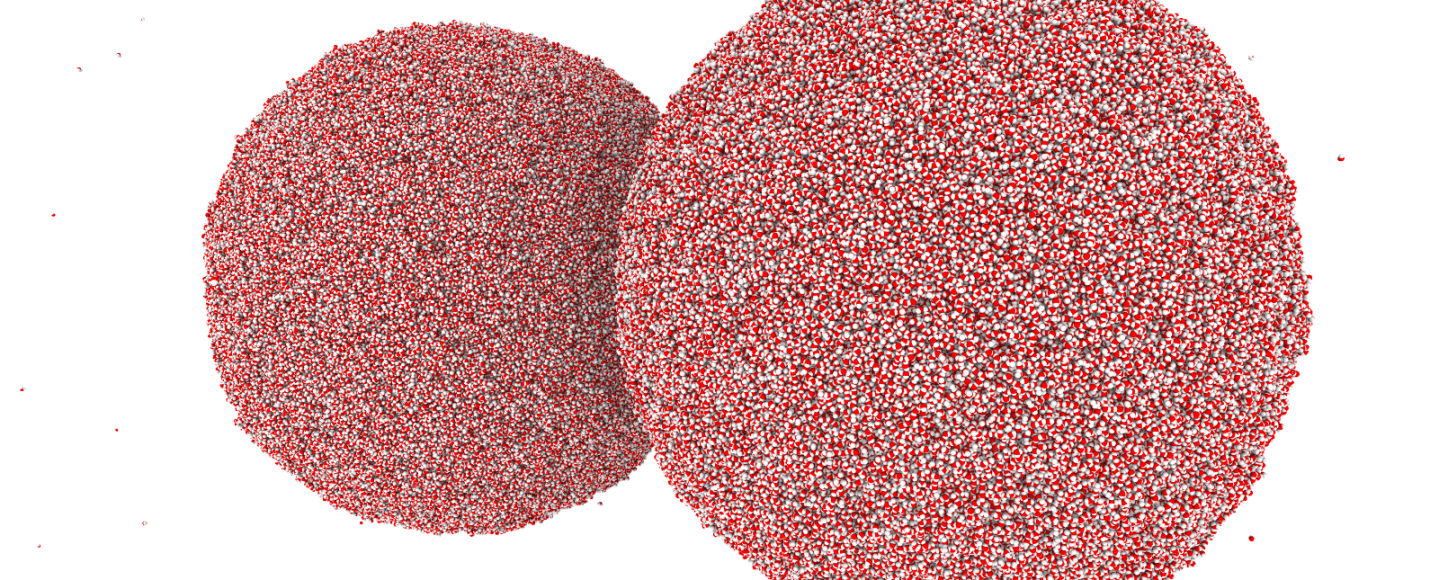
One example is droplet coalescence. When two liquid drops touch, they do not merge instantaneously. Instead, a microscopic liquid bridge forms between them and grows rapidly until the drops become one. At the nanoscale, this process is influenced by thermal fluctuations, which can excite the interface and affect how quickly the bridge develops. Using fluctuating hydrodynamics, we have shown how these nanometre-scale fluctuations set the variability in coalescence dynamics, complementing molecular simulations and experiments.
Off-centre coalescence of liquid nanodrops seen in MD.
A second example is the breakup of nanojets. While classical theory predicts smooth thinning and eventual rupture for linearly unstable cases, fluctuating hydrodynamics shows that random nanoscale waves on the interface fundamentally alter the breakup, destabilising conventionally stable configurations and even determining where pinch-off happens. This explains experimental and molecular-scale observations that could not previously be captured in a predictive framework.
Most recently, we discovered that thermal fluctuations can also trigger rupture in thin liquid films on solid surfaces. Traditionally, theories assumed films only ruptured when thin enough to be linearly unstable — the so-called spinodal regime. But our work revealed a new thermal regime, where films that appear stable can still rupture because of rare, unusually large fluctuations we call rogue nanowaves. Using molecular dynamics, stochastic thin-film models, and rare-event theory, we built the first predictive framework for this process, showing how these rogue waves puncture films and provide a new route to dewetting.
Breakup of a nanofilm of liquid on a solid.
Together, these studies demonstrate that fluctuations at the nanoscaleare often the decisive factor in determining whether drops merge, films rupture, or threads break. Our work provides the theoretical and computational foundations needed to predict these outcomes — insights that matter both for fundamental science and for applications ranging from coatings and nanotechnology to sprays, foams and beyond.

 James Sprittles
At the nanoscale, thermal motion of molecules constantly agitates fluid interfaces, creating capillary waves only nanometres in height. These thermal fluctuations, although tiny, can control the behaviour of drops, films and jets. Understanding their role is essential for predicting how fluids behave when pushed into the nanoscale, where conventional fluid models begin to break down.
Our research uses fluctuating hydrodynamics to explore this regime. This approach extends the classical Navier–Stokes equations by adding a stochastic stress term that represents molecular agitation. It provides a bridge between molecular dynamics simulations (which capture every atom but are limited in scale) and continuum models (which can simulate large systems but usually miss nanoscale physics). By combining these tools, we can capture how chance fluctuations drive processes that would be invisible in traditional theories.
One example is droplet coalescence. When two liquid drops touch, they do not merge instantaneously. Instead, a microscopic liquid bridge forms between them and grows rapidly until the drops become one. At the nanoscale, this process is influenced by thermal fluctuations, which can excite the interface and affect how quickly the bridge develops. Using fluctuating hydrodynamics, we have shown how these nanometre-scale fluctuations set the variability in coalescence dynamics, complementing molecular simulations and experiments.
A second example is the breakup of nanojets. While classical theory predicts smooth thinning and eventual rupture for linearly unstable cases, fluctuating hydrodynamics shows that random nanoscale waves on the interface fundamentally alter the breakup, destabilising conventionally stable configurations and even determining where pinch-off happens. This explains experimental and molecular-scale observations that could not previously be captured in a predictive framework.
Most recently, we discovered that thermal fluctuations can also trigger rupture in thin liquid films on solid surfaces. Traditionally, theories assumed films only ruptured when thin enough to be linearly unstable — the so-called spinodal regime. But our work revealed a new thermal regime, where films that appear stable can still rupture because of rare, unusually large fluctuations we call rogue nanowaves. Using molecular dynamics, stochastic thin-film models, and rare-event theory, we built the first predictive framework for this process, showing how these rogue waves puncture films and provide a new route to dewetting.
Together, these studies demonstrate that fluctuations at the nanoscale are often the decisive factor in determining whether drops merge, films rupture, or threads break. Our work provides the theoretical and computational foundations needed to predict these outcomes — insights that matter both for fundamental science and for applications ranging from coatings and nanotechnology to sprays, foams and beyond.
Share this: