Place a soft, water-laden hydrogel sphere on a hot plate and it does something remarkable. Instead of sitting still, it bounces — again and again, with no sign of stopping. The vapour escaping beneath it somehow feeds energy back into the sphere. The question is how.
The phenomenon is best appreciated in motion. The video below, from the Leiden group who first reported the effect, shows hydrogel spheres skipping — and audibly singing — on a hot plate, the experimental starting point for our modelling.
‘The Elastic Leidenfrost Effect’, courtesy of the Leiden Institute of Physics (Leiden University and AMOLF), accompanying Waitukaitis et al., Nat. Phys.13, 1095 (2017).
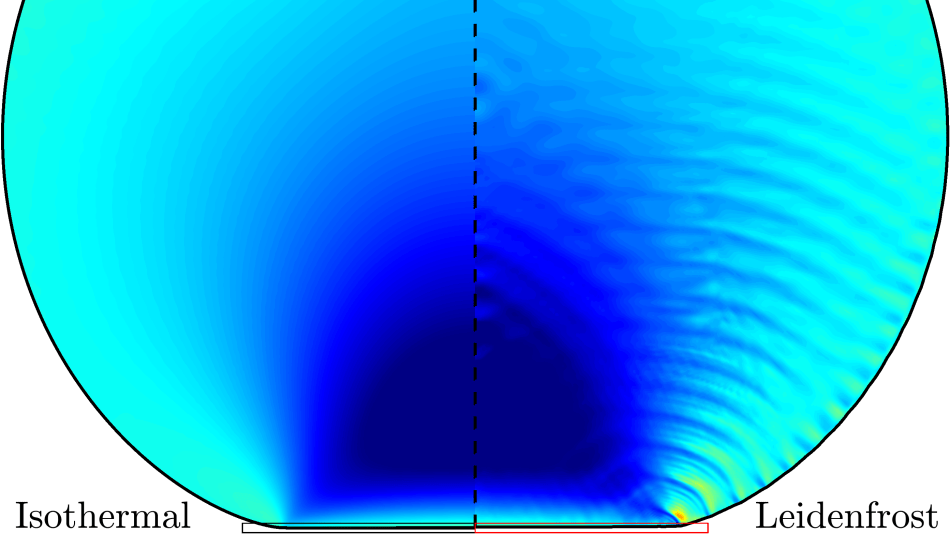
Using a computational model, we show that the bouncing is driven by an instability of elastic surface waves on the hydrogel: the evaporating film excites and sustains these waves, which in turn power the bouncing. Crucially, this happens even without the vapour becoming trapped at the solid surface — the mechanism previously thought to be responsible. The resulting dynamics follow a classical engine cycle, the same thermodynamic picture Waitukaitis and colleagues proposed.
Our simulation (Movie S2): the strain field, interface, pressure and energy exchange over one cycle of a Leidenfrost hydrogel. From Coombs et al., Phys. Rev. Research8, L022052 (2026) (CC BY 4.0).
Abstract: Leidenfrost hydrogel spheres exhibit interfacial oscillations that inject energy and drive sustained bouncing. Using a computational model, we identify these oscillations as an evaporation-driven instability of elastic surface waves. The resulting dynamics conform to a classical engine cycle [S. R. Waitukaitis et al., Nat. Phys. 13, 1095 (2017)], even in the absence of vapor trapping at the solid surface previously proposed as the injection mechanism.



Our latest paper, Leidenfrost hydrogels: elastic surface-wave instability and sustained bouncing, is now available — Open Access — as a Letter in Physical Review Research.
Place a soft, water-laden hydrogel sphere on a hot plate and it does something remarkable. Instead of sitting still, it bounces — again and again, with no sign of stopping. The vapour escaping beneath it somehow feeds energy back into the sphere. The question is how.
The effect was first uncovered experimentally by Waitukaitis and colleagues, who showed that hydrogel spheres can bounce indefinitely on a hot plate, powered by a thermodynamic engine cycle (Waitukaitis et al., Nat. Phys. 2017; Waitukaitis, Harth & van Hecke, Phys. Rev. Lett. 2018). What remained unclear was how the energy is injected.
The phenomenon is best appreciated in motion. The video below, from the Leiden group who first reported the effect, shows hydrogel spheres skipping — and audibly singing — on a hot plate, the experimental starting point for our modelling.
Using a computational model, we show that the bouncing is driven by an instability of elastic surface waves on the hydrogel: the evaporating film excites and sustains these waves, which in turn power the bouncing. Crucially, this happens even without the vapour becoming trapped at the solid surface — the mechanism previously thought to be responsible. The resulting dynamics follow a classical engine cycle, the same thermodynamic picture Waitukaitis and colleagues proposed.
The work was led by Nathan Coombs, with Peter Lewin-Jones and Mykyta Chubynsky, and builds on our earlier study of Leidenfrost levitation of soft elastic solids. The simulation code is openly available.
Abstract: Leidenfrost hydrogel spheres exhibit interfacial oscillations that inject energy and drive sustained bouncing. Using a computational model, we identify these oscillations as an evaporation-driven instability of elastic surface waves. The resulting dynamics conform to a classical engine cycle [S. R. Waitukaitis et al., Nat. Phys. 13, 1095 (2017)], even in the absence of vapor trapping at the solid surface previously proposed as the injection mechanism.
Share this: