Modelling Flows at Small Scales: From Nanofilms to Clouds
With our EPSRC Open Fellowship on drop collisions now under way, here is a short tour of the group's research and where it is heading next. There is plenty of room for new people and new ideas.
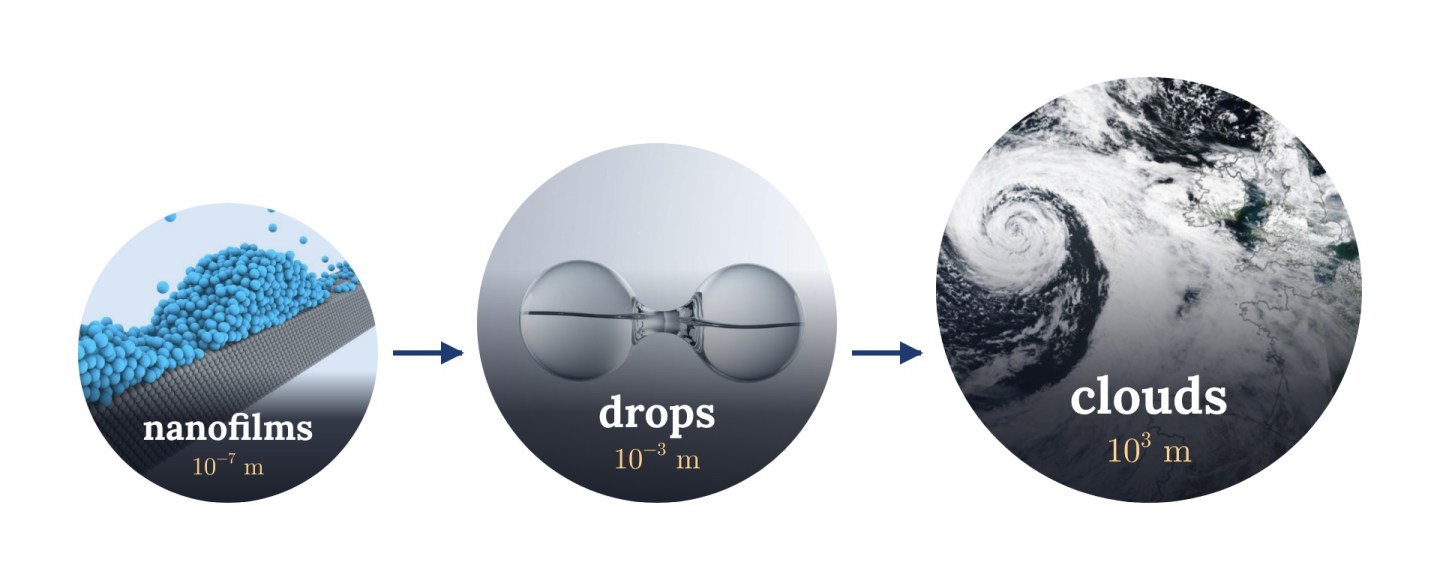
The Navier–Stokes equations describe almost every flow we meet, from the stirring of a cup of tea to the air over a wing. At the scale of a nanofilm of gas, or a liquid interface agitated by thermal motion, they stop working. Our research builds the models that take over there, uses them to resolve what happens in small scale flows such as drop collisions, jet breakup and film rupture, and carries the results up to the clouds, sprays and printers where billions of such events can decide an outcome.
Beyond Navier–Stokes
Three strands of work address what replaces the classical model. Molecular dynamics shows us where Navier–Stokes fails and what must be added: slip at a wall, thermal noise and the disjoining pressure felt by a film only nanometres thick. Fluctuating hydrodynamics builds that noise into the continuum equations. Remarkably, rare and large fluctuations can then rupture films that deterministic theory says should never break, an idea we explored in our work on rogue nanowaves. Finally, gas kinetic effects matter whenever a drop approaches a wall, or another drop, on a film of air thinner than the distance a gas molecule travels between collisions. There the gas is no longer a simple fluid and the Boltzmann equation takes over.
Drop collisions and collective behaviour
A nanofilm of air decides whether two drops bounce or merge. In a cloud or a spray that question is asked a billion billion times, and the answers set how the whole population of drops evolves. This is the focus of the Fellowship: to develop models that resolve the physics of a single collision and pass the result up to the equations for the many. The collision models used in weather and climate prediction have changed little since the 1980s, so there is a great deal to gain.
Applications
The same mathematics appears in very different places. In clouds, collisions between droplets determine when rain begins, and we work with the Met Office and NCAR to turn our results into something a weather model can use. In sprays, collisions between drops in flight set the sizes that reach their target and how much drifts away, which is the subject of our work with Syngenta. In 3D printing, microdrops must land, spread, merge and solidify in the right place.
What comes next
The open questions are the interesting part. How do rare fluctuations break a film in three dimensions? What happens when the colliding particles are ice rather than water? Can the physics of a nanofilm be embedded in a simulation of a whole collision without resolving every scale at once? And how should all of this be compressed into a form simple enough for a model of a cloud? Each of these needs a mix of asymptotics, stochastic modelling and large scale computation, and none is close to finished. Some of the directions we have in mind are described under Available Projects.
For those thinking about a PhD in this area, the main routes to funding at Warwick are the Mathematics Centre for Doctoral Training, which offers four year studentships for October 2027 and considers applications on a rolling basis, and the university’s postgraduate research scholarships, including the Chancellor’s and China Scholarship Council schemes, for which course applications close on 7 December 2026. I am always happy to talk through ideas.
The group’s research is funded by UKRI (EPSRC) and the Leverhulme Trust, with partners at the Met Office, NCAR and Syngenta.


With our EPSRC Open Fellowship programme, A Modelling Approach to Drop Collisions and their Collective Behaviour: From Nano- to Cloud-Scale Dynamics, now under way, here is a short tour of the group’s research and where it is heading next. There is plenty of room for new people and new ideas.
The Navier–Stokes equations describe almost every flow we meet, from the stirring of a cup of tea to the air over a wing. At the scale of a nanofilm of gas, or a liquid interface agitated by thermal motion, they stop working. Our research builds the models that take over there, uses them to resolve what happens in small scale flows such as drop collisions, jet breakup and film rupture, and carries the results up to the clouds, sprays and printers where billions of such events can decide an outcome.
Beyond Navier–Stokes
Three strands of work address what replaces the classical model. Molecular dynamics shows us where Navier–Stokes fails and what must be added: slip at a wall, thermal noise and the disjoining pressure felt by a film only nanometres thick. Fluctuating hydrodynamics builds that noise into the continuum equations. Remarkably, rare and large fluctuations can then rupture films that deterministic theory says should never break, an idea we explored in our work on rogue nanowaves. Finally, gas kinetic effects matter whenever a drop approaches a wall, or another drop, on a film of air thinner than the distance a gas molecule travels between collisions. There the gas is no longer a simple fluid and the Boltzmann equation takes over.
Drop collisions and collective behaviour
A nanofilm of air decides whether two drops bounce or merge. In a cloud or a spray that question is asked a billion billion times, and the answers set how the whole population of drops evolves. This is the focus of the Fellowship: to develop models that resolve the physics of a single collision and pass the result up to the equations for the many. The collision models used in weather and climate prediction have changed little since the 1980s, so there is a great deal to gain.
Applications
The same mathematics appears in very different places. In clouds, collisions between droplets determine when rain begins, and we work with the Met Office and NCAR to turn our results into something a weather model can use. In sprays, collisions between drops in flight set the sizes that reach their target and how much drifts away, which is the subject of our work with Syngenta. In 3D printing, microdrops must land, spread, merge and solidify in the right place.
What comes next
The open questions are the interesting part. How do rare fluctuations break a film in three dimensions? What happens when the colliding particles are ice rather than water? Can the physics of a nanofilm be embedded in a simulation of a whole collision without resolving every scale at once? And how should all of this be compressed into a form simple enough for a model of a cloud? Each of these needs a mix of asymptotics, stochastic modelling and large scale computation, and none is close to finished. Some of the directions we have in mind are described under Available Projects.
For those thinking about a PhD in this area, the main routes to funding at Warwick are the Mathematics Centre for Doctoral Training, which offers four year studentships for October 2027 and considers applications on a rolling basis, and the university’s postgraduate research scholarships, including the Chancellor’s and China Scholarship Council schemes, for which course applications close on 7 December 2026. I am always happy to talk through ideas.
The group’s research is funded by UKRI (EPSRC) and the Leverhulme Trust, with partners at the Met Office, NCAR and Syngenta.
Share this: